


Remi Tinubu Grants To Persons With Disabilities In Sokoto: Renewed Hope Gets Real
By: Abudu Olalekan
First Lady Remi Tinubu celebrates World Disability Day in Sokoto with huge cash grants. See how the N64m was shared to empower special citizens under the RHI scheme.
World Disability Day in Sokoto didn’t feel like a routine ceremony this year. It felt a bit different. A bit louder. More hopeful.
On Wednesday, the First Lady, Senator Oluremi Tinubu, reached people here in a very direct way – with money, yes, but also with a clear message: people living with disabilities are not an afterthought. They’re part of the plan.
She couldn’t make it in person. So she sent someone close. The wife of the Sokoto State governor, Hajiya Fatima Ahmed Aliyu, stood in for her at the event, which was quietly captured and later shared in a statement from Government House, Sokoto, signed by Abubakar Bawa, Director General, Media and Publicity. A short link on Reportersroom carried the story. The impact, though, felt bigger than the URL.
At the heart of it was money. Real naira, not promises.
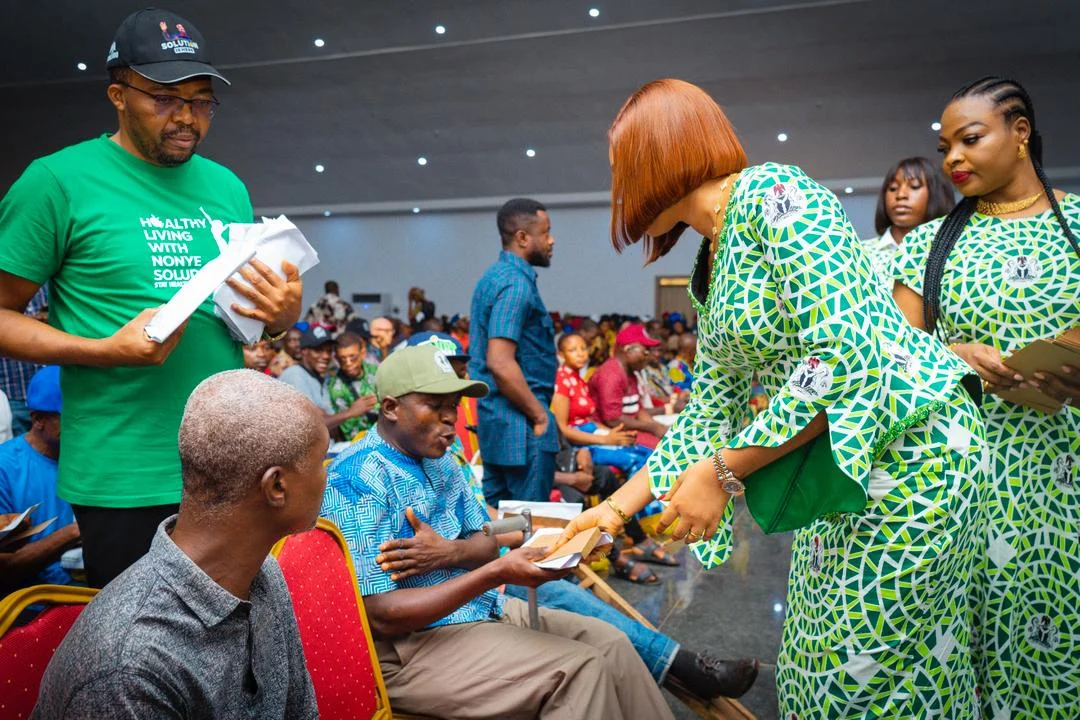
The First Lady announced the disbursement of N64 million in grants to persons with disabilities across Sokoto State. Out of this, N50 million is coming directly under the Renewed Hope Initiative, her flagship programme that has quietly been spreading across all 36 states and the FCT.
Each beneficiary under this RHI disability scheme gets N200,000. Not a loan. A grant. The plan is simple: 250 persons with disabilities per state. If you do the maths, that’s 9,500 beneficiaries nationwide and a total intervention of about N1.9 billion.
She didn’t just throw numbers around, though. According to the statement, Mrs Tinubu explained that this wasn’t some one‑off charity dash. The idea is to help people build long-term economic independence — to grow businesses, start something small, or revive what has almost died. A stepping stone. Not a one-day show.
She reminded the audience that in just about two years, the Renewed Hope Initiative has already supported over 100,000 women, petty traders and small business owners, including persons with disabilities, through direct financial grants. Real cash support, not endlessly “processing” forms.
But the First Lady was careful to stress that RHI is not about money alone.
“Our commitment to improving lives has also been demonstrated through various interventions in agriculture, economic empowerment, education, health, and social welfare,” the statement quoted her as saying. In simple terms: they’re trying to touch every corner, not just one.
She also highlighted support for victims of conflict and vulnerable families. Food assistance has gone out to 22 states and the FCT, reaching internally displaced persons and others pushed to the edge by insecurity and hardship. It’s not solving every problem, but it’s putting food on some tables that would’ve stayed empty.
In Sokoto, she didn’t forget to say thank you. She commended Governor Ahmed Aliyu for what she called consistent support for persons living with disabilities in the state. That praise didn’t come from nowhere.
During her own remarks, the governor’s wife announced an extra N2 million each to seven disability associations in Sokoto. That’s N14 million more, to strengthen empowerment schemes already running within those groups. A top‑up, you could say. Or a quiet signal that the state wants to match the First Lady’s gesture with something of its own.
Then came more details from someone who works directly with this community every day. The Special Adviser to the Governor on Disability Matters, Umar Muhammad Sabon Birni, took the microphone and broke it down.
He said the present administration had restored and increased monthly stipends for persons with disabilities from N6,500 to N10,000. Not huge, but in this economy, every extra naira counts. Right now, 6,679 registered beneficiaries are on that allowance, with plans to register more eligible persons as they’re identified.
He also talked about Ramadan. During the holy month, the state now provides special feeding centres for persons with disabilities to break their fast. It might sound small on paper, but for people often pushed to the margins of social and religious life, it means recognition. Inclusion.
Then there was a promise fulfilled. The governor, he said, recently delivered on his pledge to provide 1,000 hand‑cycles to persons with disabilities across the state. For many, that’s the difference between depending on someone to move and gliding down the street alone. Mobility. Dignity. A bit of freedom.
Sabon Birni praised the governor for his “love, support, and care for persons living with disabilities,” and urged beneficiaries not just to collect and go, but to support the administration’s programmes in return.
The event wasn’t all speeches and handshakes. There was sports. Energy. A para-soccer match pitched the governor’s team against his wife’s side. In the end, the First Lady’s team beat the governor’s team 2–1. Light-hearted, yes, but also a reminder that disability does not mean inability.
The Sokoto Para-Soccer Team had their own moment too. They presented a trophy to the governor’s wife – one they won in a competition that featured teams from Sokoto, Kebbi and Zamfara. A quiet proof that given the right support, they don’t just participate. They win.
In a goodwill message, Sultan Muhammad Sa’ad Abubakar, represented by Ubandoman Arkilla, Alhaji Aliyu Hassan, applauded Governor Aliyu’s “people-oriented projects”. He also promised that the Sultanate Council would keep backing the government on initiatives like this.
So yes, it was one event. One state. One set of grants.
But for a lot of people in Sokoto living with disabilities, it was also something more.
It was a reminder that someone in Abuja, and someone in Government House, still remembers their names.

Olalekan A. Abudu is a seasoned and dedicated News Journalist at REPORTERS ROOM, with over eight years of experience. He specializes in politics, climate change, health, and education, while also covering security, economic, and judicial issues. Committed to accuracy and balanced reporting, Olalekan exemplifies the principles of public-interest journalism.
