


Europe’s Relentless Heatwave Would Have Been “Nearly Impossible” 50 Years Ago, Scientists Say
By: Oluwaseun M. Lawal
In the summer of 1976, Europeans complained about the heat. Crops dried up. Rivers shrank. Records were set. It was, at the time, unforgettable.
Today, that same heat would barely raise eyebrows.
A new scientific analysis says the brutal heatwave now gripping large parts of Europe — smashing records from London to Rome — would have been “virtually impossible” half a century ago. Not unlikely. Not rare. Impossible.
That’s the word researchers from World Weather Attribution used after studying the numbers behind this ongoing event. And they were blunt about the cause: human-driven climate change.
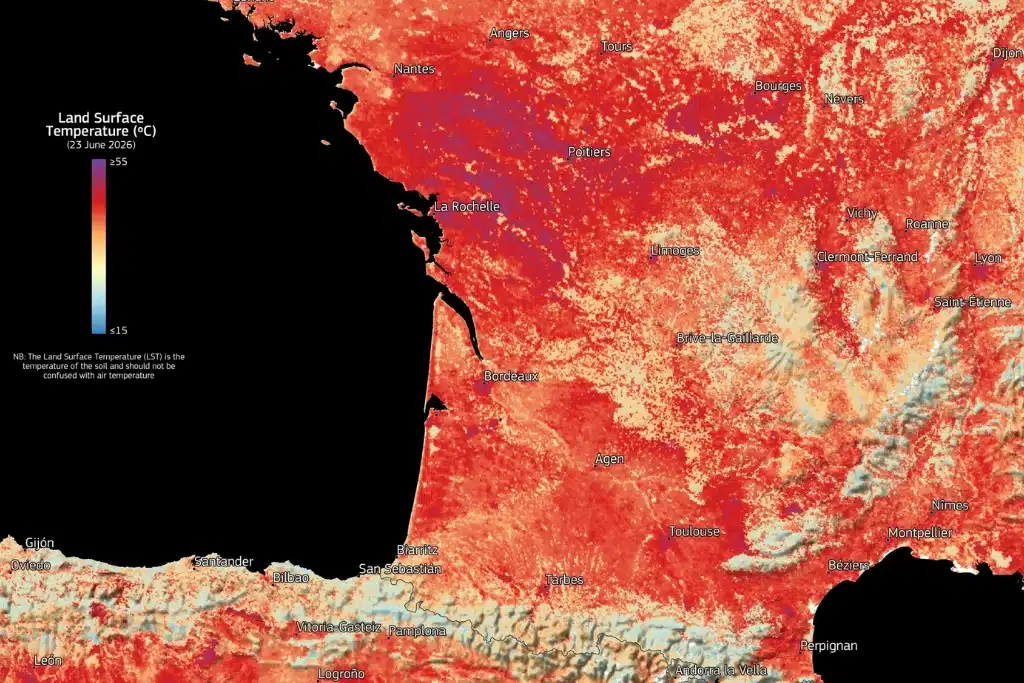
Across northern, western and central Europe, thermometers have climbed into dangerous territory. Red alerts are flashing in the UK, Germany, Austria, Switzerland, Italy, Spain and France. Cities built for mild summers are suddenly baking. Stone buildings trapping heat. Rail tracks warping. People queuing for water fountains.
According to the researchers, this is now the most severe heatwave ever recorded in the region.
To understand how unusual it is, scientists compared today’s temperatures to those during previous landmark European heatwaves — especially 1976 and 2003. Back in 1976, global temperatures were about 1.1°C cooler than today. In 2003, around 0.6°C cooler.
That difference may sound small. It’s not.
Researchers found that a heatwave of this magnitude in 1976 would have been “virtually impossible.” And even in 2003 — the year Europe experienced one of its deadliest summers — the likelihood of seeing this kind of extreme heat at this point in the season was tens to hundreds of times lower.
In other words, this isn’t just bad luck weather. The baseline has shifted.
The planet today is roughly 1.4°C warmer than it was before the industrial era. That background warming loads the dice. It makes extremes more extreme.

Nearly half — about 45% — of 854 cities examined across 30 European countries have either broken or are expected to break their all-time wet-bulb globe temperature records this week. That measurement matters. It factors in both heat and humidity, giving a clearer picture of how stressful conditions are on the human body.
Because heat alone doesn’t tell the full story.
When humidity climbs, sweat struggles to evaporate. And sweat is how the body cools itself. If what scientists call the wet-bulb temperature hits 35°C — a theoretical upper survival limit — the human body can no longer regulate its internal temperature properly. Overheating can happen fast. It can be fatal.
We are not quite there across most of Europe. But the numbers are edging closer than they used to. That should worry people.
An earlier study in late 2023 warned that by the end of this century, some parts of the world could experience lethal combinations of heat and humidity for hours, days — even weeks. Outdoors would not just be uncomfortable. It would be unsafe.
What’s more alarming is how fast the extremes are accelerating.
The new analysis shows that Europe’s hottest daytime temperatures are rising at roughly three times the rate of global warming. Nighttime temperatures? About twice the rate.
Hot nights are especially dangerous. They steal recovery time.
When temperatures stay above 28°C after sunset for several days in a row, the health risks climb. A 2020 study found that five consecutive “hot nights” raised the risk of death by nearly 7%. Sleep suffers. The heart works harder. The vulnerable — elderly people, children, those with chronic illness — face the greatest danger.
And here’s another problem: air conditioning.
In the United States, around 90% of households have some form of cooling. In China, roughly 60%. In Europe? Only about 10%. In India, even less.
Many European homes were designed to keep heat in, not out. Thick walls. Limited ventilation. Great for cold winters. Terrible for prolonged heatwaves.
The UK’s independent Climate Change Committee recently warned that over 90% of existing homes in Britain could overheat during severe heat events. That’s most houses. Most flats. Most care homes.
Europe is warming faster than any other continent. Over the past two decades, heat-related deaths have increased by around 30%. In 2023 alone, nearly 48,000 deaths across the continent were linked to extreme heat.
Behind each number is a person. A family. A story.
Carolina Pereira Marghidan from the Red Cross Red Crescent Climate Centre urged people to take local heat advisories seriously — stay hydrated, avoid peak sun, seek cooler spaces. Simple advice. But not always simple to follow.
Awareness has grown, she said. People understand the risks more than they did decades ago. Yet awareness isn’t infrastructure. It doesn’t redesign buildings. It doesn’t plant shade trees overnight. It doesn’t magically install cooling systems where none exist.
The science is becoming harder to ignore. What once would have been considered extraordinary is now happening with unsettling regularity.
The summer of 1976 shocked Europe.
The summer of now? It may just be a preview.

Oluwaseun Musa Lawal is an Editor at REPORTERS ROOM with over eight years of professional journalism experience. He specializes in reporting on politics, climate change, health, and education, while also covering security, economic, and judicial affairs. His work is driven by a commitment to accuracy, balanced reporting, and public-interest journalism.

