



Wildfires in Spain and France Displace Over Three Hundred Thousand as Blazes Rage Out of Control
By: Abudu Olalekan
It’s hard to overstate what’s happening right now across southern Europe. More than three hundred thousand people have been displaced by wildfires tearing through France and Spain, and honestly, the numbers keep climbing.
Spain declared a national emergency. That alone tells you how bad things are.
The country’s interior ministry says fires have ravaged nearly ten thousand hectares in the Madrid region and somewhere between thirteen thousand and fifteen thousand hectares in neighbouring Ávila province. The head of the Madrid regional government has called these fires the worst the area has ever seen. And he’s not exaggerating — hundreds of firefighters were battling to stop two separate blazes west of Madrid from merging, with fires scorching nearly forty-five thousand hectares and forcing around ninety thousand people to evacuate or shelter.
Over in France, about sixty-three thousand people have evacuated from southern regions as multiple fires burn simultaneously, already destroying roughly eighty homes. France has staged its biggest peacetime evacuation since World War II as fires rage in the Gironde region. That’s not a typo. Since World War II. Let that sink in.
France has also called on the EU’s Civil Protection Mechanism for international backup.
This Isn’t Just “A Bad Summer”
Here’s where it gets really alarming. The amount of land burned by wildfires across Europe has surged by fifty-seven percent in just four years, according to new data from the World Health Organization’s European office. Wildfires destroyed two point two million hectares across the WHO European Region in the previous year alone — up from one point four million hectares back in twenty-twenty-two. That’s a trajectory that lines up almost perfectly with rising global temperatures. And we’re barely into the current fire season.
In Spain and Portugal alone, the number of wildfires has more than doubled since last year. We’re not talking about a slow trend anymore. It’s accelerating. Fast.
350.org: “We’re Living It”
Environmental campaign group 350.org didn’t mince words. They say the wildfire crisis exposes the real cost of fossil fuel delay — and makes clear who’s actually paying for it.
Soraya Fettih, a global campaigner at 350.org who lives near Bordeaux, shared her own experience. She was evacuated from her home on Saturday morning. The fire had reached the suburbs of Bordeaux. Black sky. Ash in the air. People forced to flee from the coast and suburbs, pouring into the city.
“This isn’t something we’re watching on the news,” she said. “We’re living it.”
And then she pointed to the money side of things — because the contrast is honestly staggering. TotalEnergies reported billions in net income for the first half of the year, a seventy-two percent increase compared to the same period last year. That’s happening while communities around Bordeaux choke on smoke and watch their forests turn to ash.
Fettih put it bluntly: her people are losing homes, memories, communities. Their lives are turning to ash. And meanwhile, she says, governments keep subsidising the very fossil fuel companies driving the crisis. Communities are paying twice — once through climate disasters, and again through public money propping up the companies that profit from them.
TotalEnergies’ Profits Keep Climbing
The timing here is hard to ignore. TotalEnergies’ second quarter adjusted net income rose sixty-seven percent, driven by surging oil prices and exceptionally strong refining margins due to disruptions from the war in Iran. That’s not some minor bump. It’s a massive windfall.
350.org is calling on European governments to make fossil fuel companies pay for the damage they’re profiting from. They want permanent higher taxes on fossil fuels and a climate damages tax on oil and gas profits — money that would go toward emergency response, recovery, and building long-term resilience for the communities getting hit hardest.
The group also acknowledged this situation is moving quickly. Numbers will likely change as the fires keep burning and full damage assessments come in. A total economic cost estimate for the current fire season? Not even available yet.
EU Steps In With Aircraft and Firefighters
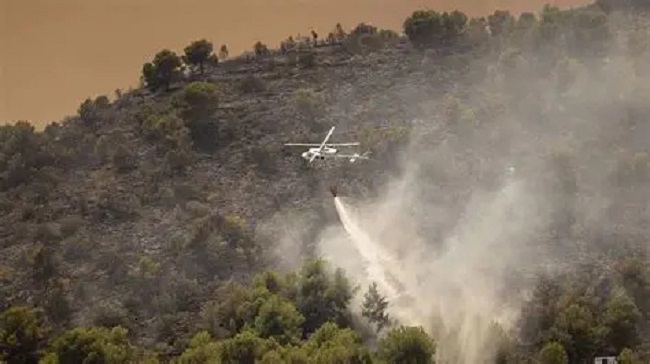
Meanwhile, Europe is rallying. The European Union has deployed firefighting aircraft, personnel and equipment to France and Spain as the wildfires have displaced more than three hundred thousand people and prompted one of Europe’s largest evacuation operations.
Here’s what’s been sent so far:
France has received planes and helicopters from Czechia, Croatia, Germany, Portugal, Slovakia, Sweden, and Turkey. Spain has gotten planes from Greece, Italy, and Turkey, plus ground teams with personnel and vehicles from Portugal.
The assistance was mobilized through the EU Civil Protection Mechanism. The EU’s Copernicus satellite service is also providing rapid emergency maps to support response on the ground.
EU Crisis Commissioner Hadja Lahbib didn’t hold back either. She said no country should have to face a disaster of this scale on its own.
“To the people of France and Spain: Europe will stand with you until the fires are out,” she said.
That’s the kind of statement you hope actually translates into sustained support. Because at this rate? These communities are going to need it.

Olalekan A. Abudu is a seasoned and dedicated News Journalist at REPORTERS ROOM, with over eight years of experience. He specializes in politics, climate change, health, and education, while also covering security, economic, and judicial issues. Committed to accuracy and balanced reporting, Olalekan exemplifies the principles of public-interest journalism.
