


Army Chief Gives Update on Abducted Oyo Pupils, Teachers as Rescue Ops Intensify
By: Abudu Olalekan
There is finally some news on the 39 pupils and seven teachers taken from their schools in Oyo State. And according to the Chief of Army Staff, things are moving.
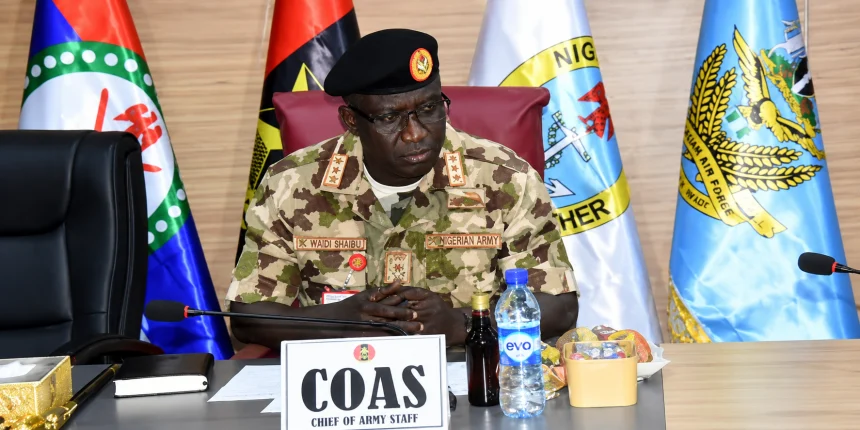
Lt.-Gen. Waidi Shaibu broke his silence on Saturday. He was in Port Harcourt for an interactive session with media executives, part of the 2026 Nigerian Army Day Celebration. The question on everyone’s mind? Those kids still missing since May 15.
“Operations are currently ongoing to rescue those children abducted in Oyo State, and we are making tremendous progress,” Shaibu said.
Short. Direct. But you could hear the confidence behind it.
He believes the operation will end with the victims back home. Safe. Reunited with their families. No timelines given, though. And in rescue operations, that’s usually how it goes.
Shaibu didn’t just talk about Oyo. He painted a picture of an Army stretched across all six geopolitical zones, trying to plug every leak in the dam.
In the North-East, Operation Hadin Kai have been busy. He said they recently took out a high-profile Islamic State commander, Abu Bilal al-Minuki, with help from American partners. Over 1,872 insurgents neutralised. Many others surrendered. Because of this, some displaced communities are finally seeing home again. The IDP camp in Bama, Borno, just closed its doors.
That’s huge.
Up in the North-West, Operation Fansan Yamma is still hunting bandits. Neutralising criminals. Recovering weapons. The usual grind.
He also touched on the North-Central. Operations Enduring Peace, Whirl Stroke, and the new kid on the block, Operation Savannah Shield. Security has improved in Plateau, Benue, Nasarawa, Kwara, Niger and parts of Kogi. Things are quieter now.
The South-East? Shaibu said the situation has improved. Christmas came and went without any reported disruptions. That’s saying something.
Down in the South-South, oil output is up. Shaibu ties that directly to the Army’s crackdown on illegal bunkering, crude theft and pipeline vandalism.
South-West is one of the most peaceful regions, he noted. Well, except for the Oyo abduction that started this whole conversation.
Now, here is where it gets interesting. The Federal Government is not just relying on the current troops. They want more boots on the ground.
President Tinubu approved a new Army depot in Amasiri-Edda, Ebonyi State. That makes three depots now. Zaria in Kaduna, Osogbo in Osun, and this new one in Ebonyi.
Shaibu said they are recruiting and training 28,000 young Nigerians across these facilities. The numbers so far? Zaria has graduated 6,000 soldiers. Osogbo turned out 5,000. Amasiri-Edda will soon add 3,000 more. That brings the total to 14,000.
“I recently directed the recruitment of 28,000 young Nigerians to enhance manpower for our various operations across the country,” he stated.
Training got longer too. Recruits now undergoes about 11 months of intensive military training. Marksmanship, counter-insurgency, counter-terrorism. Advanced infantry drills. Acclimatisation exercises. The curriculum has been revamped to meet today’s threats.
And they are shopping for hardware.
Armoured personnel carriers. Mine-resistant vehicles. Drones. Both armed and surveillance types. Shaibu said personnel have been sent for specialised training inside and outside Nigeria to handle this modern equipment.
“The acquisition of armed and surveillance drones, alongside enhanced aviation capabilities, has improved response times and operational success across theatres of operation,” he added.
At the end of the day, Shaibu wanted one thing clear. The Army is not backing down. Not in Oyo. Not anywhere else. They will respond to every security challenge thrown at them.

Olalekan A. Abudu is a seasoned and dedicated News Journalist at REPORTERS ROOM, with over eight years of experience. He specializes in politics, climate change, health, and education, while also covering security, economic, and judicial issues. Committed to accuracy and balanced reporting, Olalekan exemplifies the principles of public-interest journalism.