


Overshoot Explained: Five Things to Understand About a World Beyond 1.5°C
By: Abudu Olalekan
For the first time in recorded history, 2024 saw the world’s average temperature go above 1.5°C compared to pre-industrial levels.
That alone was enough to raise alarm bells. But climate scientists don’t judge the course of global warming by a single year. Still, the writing was on the wall — we’re clearly headed for a world that’s warmer than the Paris Agreement had hoped for. If every climate pledge and policy currently on the table is actually carried out, we’re looking at at least 1.8°C of warming.
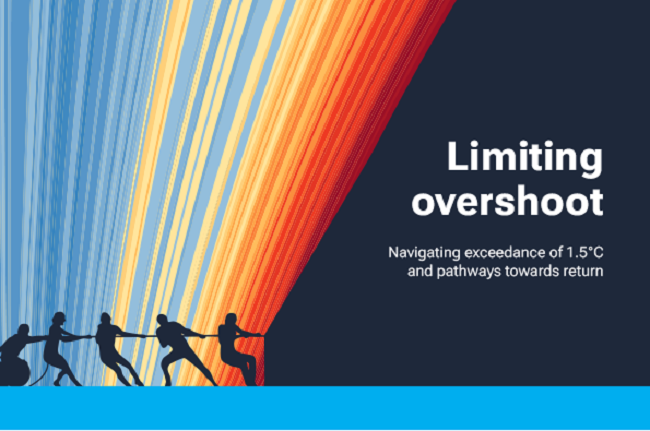
A new United Nations Environment Programme (UNEP) report, Limiting Overshoot, doesn’t shy away from that reality. It admits the world will likely overshoot the 1.5°C target. The key, it says, is to make that overshoot as small and as short as possible — and then work to bring temperatures back down again. It’s not the path anyone wanted. But it’s the one we’re on, and we’d better be ready for it.
UNEP has already laid out plenty of solutions to limit overshoot in its previous reports. This one focuses more on what’s truly at stake if we don’t act fast enough to scale them up.
So, what exactly does “overshoot” mean for all of us? Here’s a plain breakdown of five things worth knowing.
1. Overshoot is a path — not a single moment in time
Global temperatures don’t just jump overnight. They rise over decades.
Ideally, instead of blasting past 1.5°C and staying there, we could peak just above it, then bring it back down over time. The report calls this an “overshoot peak and decline pathway” — or simply an “overshoot pathway”. It plays out in four stages: exceedance (going past 1.5°C), reaching a peak (ideally under 2°C), declining, and finally stabilising.
None of those stages are set in stone, though. The shape of that curve depends entirely on the choices we make and the actions we take from here on out.
How long we stay above 1.5°C, and just how high that peak goes, will make all the difference to how badly people and nature feel the impacts. Even more importantly, bringing temperatures back down to 1.5°C — or below — isn’t guaranteed. It all hinges on the mitigation work we do now and keep doing in the years ahead. The shorter and flatter that curve is, the better off we’ll be.
2. Going above 1.5°C must never mean giving up on it
The Paris Agreement clearly commits countries to keep warming “well below 2°C”, aiming for 1.5°C. But let’s be clear — 1.5°C was never a safe threshold to begin with.
We’re already seeing it play out: more brutal heatwaves, raging wildfires, longer droughts, and more extreme storms. As we push past 1.5°C, those impacts won’t just get worse — they’ll intensify faster, pile on top of one another, and could even trigger irreversible tipping points. We’re talking about the potential dieback of the Amazon, thawing permafrost, and the collapse of major ice sheets.
The costs of fixing this would also shoot up, forcing us to lean heavily on carbon dioxide removal instead of just cutting emissions. Adaptation would become harder too, raising some very real questions of justice — from forced migration and the submersion of Small Island Developing States, to a projected 14% drop in global food production by 2050.
For all these reasons, the top priority still has to be slashing emissions, fast and consistently. Talking about overshoot isn’t a way to dodge prevention. It’s about responsibly preparing for a risk we’re getting closer to by the day.
As Mirey Atallah, Chief of UNEP’s Adaptation and Resilience Branch and coordinator of the report, puts it: “Decisions, science and, most importantly, mindsets need to shift to seeing 1.5°C as a goal we’ll be approaching from above rather than below. This is the starting point for realizing just how imperative it is to massively reduce emissions and minimize the severity of the overshoot pathway we’re on.”
3. Adaptation and mitigation have to go hand-in-hand
For far too long, we’ve treated cutting emissions (mitigation) and preparing for climate impacts (adaptation) as two separate battles. The report makes it clear: we can’t afford to do that anymore.
Both need to be ramped up at the same time, at scale, with more ambition — and they need to reinforce each other. Getting to net-zero might stop warming from getting worse. But to actually bring temperatures back down below 1.5°C again, we’ll need to go net-negative.
The two also feed into each other in very practical ways. The adaptation we do today helps protect our ability to keep mitigating tomorrow. At the same time, how much we mitigate now will determine just how hard we’ll have to adapt in the future. If mitigation falls short, we risk hitting hard adaptation limits — points where the climate becomes so extreme that there’s simply no way to adapt to it anymore.
4. Carbon dioxide removal helps — but it’s no silver bullet
Carbon dioxide removal (CDR) is exactly what it sounds like: pulling CO₂ out of the atmosphere and storing it safely. The report is clear that even the least severe overshoot pathways will still need a lot more of it.
It splits CDR into two types. First, there’s conventional CDR — things like planting trees, restoring forests and improving soil management to store more carbon in nature. Then there’s novel CDR, which relies on technology, like direct air capture, to pull carbon straight out of the air.
Conventional CDR is currently the most realistic option. But it comes with its own trade-offs. It needs land, which means we’ll have to be smarter about how we use it — especially when it comes to food production and people’s livelihoods. It also isn’t foolproof. Rising temperatures, droughts or wildfires can all release that stored carbon right back into the atmosphere.
Novel CDR is a different story. It’s still unproven at scale, and it’s very expensive — costing up to US$600 per tonne of CO₂ removed. To make any meaningful dent, the report notes it would need to triple or even quadruple its current removal capacity by 2050. On top of that, we still lack the governance and capacity to roll it out properly.
According to the models, CDR could only reverse a few tenths of a degree of warming this century. That’s an important contribution, no doubt. But as the report warns, it can never be a substitute for rapidly cutting carbon dioxide, methane and other greenhouse gases.
5. Cooler temperatures won’t just snap us back to “normal”
It’s tempting to think that if we bring temperatures back down, the world will go back to the way it was. Unfortunately, that’s not how our planet works.
By overshooting 1.5°C, many changes to both nature and human societies are already locked in. The big problem? These changes don’t all happen at the same pace. Some are fast, others unfold over decades — or even centuries. Sea-level rise, melting ice, species loss, ecosystem shifts, human displacement, changing food and water supplies… there’s still a lot of uncertainty around how all of these will play out as temperatures fall again.
As Atallah explains: “The climate system behaves like an enormous boiler. Cutting emissions turns down the flame; reaching net-zero stops adding to the heating. But the heat already accumulated does not disappear. The oceans, ice sheets and ecosystems take decades, or much longer, to respond, and bringing temperatures back down requires more than simply turning off the gas. This makes the future very difficult to predict.”
That uncertainty is exactly why the “decline” phase of the overshoot pathway needs much more scientific attention. The report’s authors hope their work sparks that much-needed research.
It also raises some deeply human and political questions. Who gets to decide what we protect, rebuild or leave behind? What happens to communities that hit their adaptation limits? What about places that become uninhabitable? And who will bear the costs?
The report’s central message is simple, yet sobering: we must limit those unknowns as much as we can. That means keeping the peak of warming as low as possible, shortening how long we stay above 1.5°C, and acting now to preserve as many options for our future as we possibly can.
After all, as the report puts it, “Every fraction of a degree avoided reduces risks. Every year by which overshoot duration is shortened reduces exposure. Every investment in resilience preserves future options.”

Olalekan A. Abudu is a seasoned and dedicated News Journalist at REPORTERS ROOM, with over eight years of experience. He specializes in politics, climate change, health, and education, while also covering security, economic, and judicial issues. Committed to accuracy and balanced reporting, Olalekan exemplifies the principles of public-interest journalism.