


Taraba Climate Change Policy 2026: Kefas Unveils Action Plan
By: Abudu Olalekan
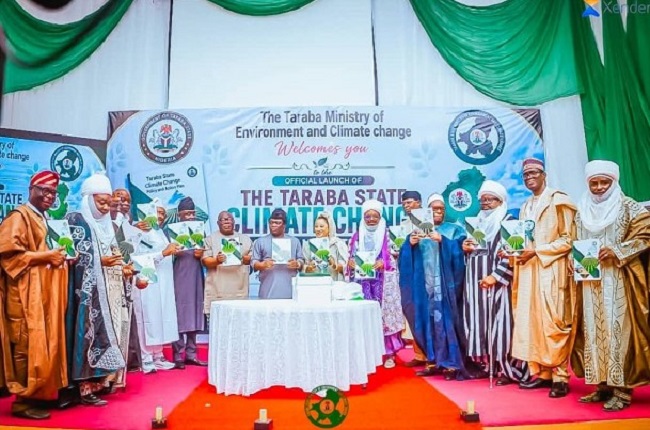
The Taraba Climate Change Policy 2026 has been launched by Governor Agbu Kefas in Jalingo on Friday, 21st August 2026. The Governor charged stakeholders to make climate change a priority in the state’s agenda of environmental protection, adaptation, and resilience-building.
Senior officials, academicians, climate experts, partners, and stakeholders were present at the event.
Governor Kefas sees this as a moment to signal the state’s commitment to climate change adaptation and integration into all aspects of governance, policy, and development.
He charged the ministry, councils, communities, and partners to collaborate in executing the policy to ensure it bears fruits in time.
The Governor stated that the Climate Change Policy and Action Plan provide opportunities for increased production in the state’s agriculture, developmental, and environmental sectors while building resilience to the impacts of climate change.
He directed the Ministry of Environment and Climate Change to come up with a framework for the implementation of the policy, which will contain timelines and targets.

Governor Kefas requested the Ministry to mobilize the state to take advantage of emerging carbon markets and leverage partnerships to attract climate finance and investors to the state.
He further charged the Local Government authorities to ensure that all wards are included in the implementation framework, saying climate change adaptation and resilience-building will be part of the agenda in Taraba State.
The Governor asked the people of Taraba to lay their responsibilities on the shoulders of the government and abide by the rules and regulations put in place for the sustainability of the environment.
The Commissioner for Environment and Climate Change, Hajiya Aishat A. Barde, described the day as a historic moment for the people of Taraba State.
The Commissioner stated that the document is a roadmap for climate governance, nature conservation, reduced greenhouse gas emissions, and building resilient communities.
According to the commissioner, the policy creates an opportunity for accessing climate finance that will support the state’s developmental agenda.
Ms. Barde noted that the document was developed through extensive consultations, technical preparations, and the inputs of various government agencies.
Civil society organizations, community leaders, development partners, and subject matter experts all contributed to the making of the document.
She acknowledged Governor Kefas for his commitment, leadership role, and deliberate efforts in providing an enabling environment for climate change action in the state.
Commissioner Barde also thanked Natural Eco Capital, Society for Planet and Prosperity, and African Climate Foundation for their enormous support in terms of funds and expertise and the Technical Working Committee Members for their inputs, time, and effort in the successful completion of the draft policy.
She appealed to the ministries, local government councils, traditional leaders, communities, youths, and women’s groups, partners, and stakeholders to embrace the plan and make it work.
Climate change adaptation requires the commitment of all agencies in the state government. It is not the sole responsibility of the Ministry of Environment and Climate Change.
“I am optimistic that with the collective efforts of all agencies, local government councils, traditional leaders, communities, youths, and women’s groups and partners, we will achieve climate change adaptation and build Taraba State as an environmentally sustainable and economically viable region,” the commissioner said.
Dr. Eugene Ituwa, Chief Executive Officer of Natural Eco Capital, and a member of the Technical Working Committee presented a paper on climate change and commended the government for developing this type of roadmap for the state.
He described the document as a climate action plan that the people of Taraba will use to transform their communities by adapting to climate change and reducing their emissions.
Warm speeches and statements were made by Dr. Tafarki Agbadu Eneme, Member, Kurmi Constituency, and Chairman Taraba State House of Assembly Committee on Environment and Climate Change, Prof. Mahmoud Abdullahi, Deputy Vice Chancellor of Taraba State University, Prof. Oladipo Emmanuel of the University of Lagos, and Dr. Vincent Ndukka Ojeh of Taraba State University.
The stakeholders appreciated the leadership and hard work of the state government in developing the policy but reminded the government that the implementation of the roadmap is the ultimate test.
They challenged the state government to ensure that the proposed interventions bear fruits and contribute to the environmental, economic, and social well-being of the people of Taraba State.

Olalekan A. Abudu is a seasoned and dedicated News Journalist at REPORTERS ROOM, with over eight years of experience. He specializes in politics, climate change, health, and education, while also covering security, economic, and judicial issues. Committed to accuracy and balanced reporting, Olalekan exemplifies the principles of public-interest journalism.