


Security Everywhere. Materials Moving. Ekiti Is Ready — Or Is It?
By: Abudu Olalekan
Two days. That’s all the time left before Ekiti State goes to the polls in what many are calling one of the most closely watched off-cycle elections in recent memory. And from the looks of things, nobody is taking any chances.
On Wednesday, the streets of Ado Ekiti were buzzing with a kind of organised tension you only see before elections. Security agencies were out in full force. INEC officials were moving from one location to another. Civil society groups were wrapping up training sessions. Everybody had a role to play. Everybody knew the stakes.
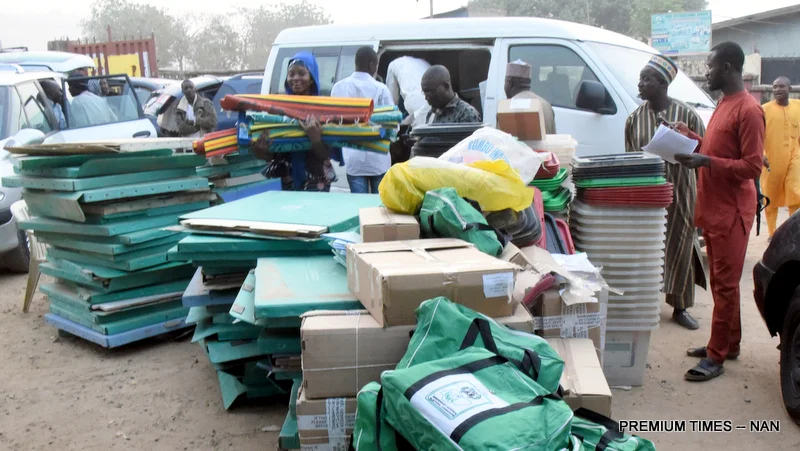
The Independent National Electoral Commission announced that Thursday is the day — the day sensitive materials start moving to all 16 local government areas. We’re talking ballot papers, Bimodal Voter Accreditation System machines, voter registers. The whole kit.
And then there’s the security. Oh, the security.
10,000 Officers and Counting
The Nigeria Security and Civil Defence Corps doesn’t want to be vague about numbers. They’ve deployed 10,000 personnel across Ekiti State. Ten thousand. Officers were pulled from Ondo, Osun, Oyo, Lagos, Kwara, Edo, Ogun and Kogi commands. Reinforcements came in from Zone 11 and Zone 6.
They didn’t stop at regular officers either. The Corps has sent in the heavyweights — the Commandant General’s Special Intelligence Squad, the Special Weapons and Tactics unit, the Specialized Female Squad, Mining Marshals, the Special Force and Crack Squad, and the K9 Unit. Yes, dogs are coming too.
“We will tolerate no form of electoral violence, thuggery, or disruption,” the NSCDC said in a statement. Strong words. But in a country where election day can turn chaotic in the blink of an eye, you can understand why they’re not leaving anything to chance.
The Police Are Not Sleeping Either
The Commissioner of Police for the election, Abayomi Shogunle, already assumed duty and started rolling out security protocols approved by the Inspector-General of Police. Intelligence mapping is underway. They’ve identified potential flashpoints. Plans are in place for the secured movement of materials and personnel.
Sunday Abutu, the state Police Public Relations Officer, broke it down in a statement. The goal, he said, is to protect polling units, collation centres, electoral workers, voters, observers, journalists — basically everyone and everything that matters on election day.
Shogunle told residents to cooperate with security agencies. He also made it clear that officers deployed for election duties had been briefed and would operate strictly within the law.
“We can’t give you the figure,” ACP Anthony Placid told reporters when asked exactly how many police officers would be on ground. But he confirmed that deployment started from Wednesday the 17th. “From June 17th, men will be on the ground,” he said.
The Air Force Took to the Skies
Here’s something most people didn’t see coming — the Nigerian Air Force airlifted sensitive electoral materials from Abuja to various states ahead of the elections. The operation ran between June 15 and 16 after INEC made the request.
Air Commodore Ehimen Ejodame, the NAF Director of Public Relations and Information, explained that the mission was to guarantee secure and timely transportation of materials from the Nnamdi Azikiwe International Airport to designated locations. It wasn’t just Ekiti. The airlift also covered by-elections in Enugu North, Nasarawa North, Rivers South-East, and federal constituencies in Kano and Kebbi states.
“The successful airlift underscores the Service’s unwavering commitment to supporting democratic institutions,” said Air Marshal Sunday Kelvin Aneke, the Chief of the Air Staff. He praised the personnel involved and said the Force remains committed to helping civil authorities whenever the need arises.
What’s at Stake?
Ekiti voters will elect a governor from 13 political parties spread across 16 local government areas, 177 wards and over 2,000 polling units. The election is being seen as a major political test ahead of the 2027 general elections.
Though more than a dozen parties are in the race, political observers say it’s really a three-horse contest. Governor Biodun Oyebanji is running on the APC platform, seeking a second term. The PDP’s candidate is Dr Wole Oluyede. And Dare Bejide is carrying the ADC flag.
All three have spent weeks crisscrossing the state, visiting communities, making promises, shaking hands. The campaigns have been intense but — and this is worth noting — surprisingly peaceful by Nigerian standards.
The Tribunal Is Ready
Just in case things don’t go smoothly on Saturday, the Court of Appeal has already constituted the Ekiti State Governorship Election Petitions Tribunal. President of the Court of Appeal, Justice Monica Dongban-Mensem, set it up and the Chief Judge of Ekiti State approved the use of the National Industrial Court premises in Ado Ekiti as the venue.
The tribunal will handle any petitions that come out of the election results. Better to have it ready and not need it, right?
Making Sure Nobody Is Left Behind
One of the more heartening aspects of this election is the effort to include persons with disabilities. TAF Africa, a civil society organisation focused on disability inclusion, is deploying 150 election observers across the state. They’re also sending 25 sign language interpreters to polling units where voters have hearing impairments.
Dr Andrew Adaji, TAF Africa’s Programmes Manager, spoke during a training session in Ado Ekiti. “We are deploying sign language interpreters, about 25 of them,” he said. “We will put them in units where we have persons with hearing impediments or the deaf.”
The observers will use a dedicated app — the TAF Africa election app — designed with support from the EU-SDGN, to monitor and report in real time from the field. The goal is simple: make sure persons with disabilities are not excluded from the process.
“Over time, PWDs have been excluded in so many things,” Adaji added. “This time around, we look at the accessibility of the polling unit.”
Oyebanji’s Broadcast
Wednesday evening, Governor Oyebanji addressed the state in a broadcast. He talked about his three and a half years in office, claiming he had delivered on campaign promises and provided good governance.
“As we approach the polls, I want to humbly request that you renew the Shared Prosperity Mandate you gave us four years ago by another four years,” he said.
He spoke about laying a solid foundation of economic prosperity and promised that a second term would bring “higher velocity of development.” He referenced the administration’s 30-year Development Plan and urged stakeholders, party members, observers and security agencies to act with professionalism and fairness.
“So far, this current political electioneering has been the most peaceful in the history of our state,” Oyebanji said. “And we must do everything to ensure that the election and post-election activities remain peaceful.”
So What Happens Now?
With sensitive materials on the move, security personnel deployed across the state and election officials finalising the last bits of logistics, the countdown to Saturday is real.
The question isn’t really whether the election will hold — it will. The question is whether it will be peaceful, transparent and credible enough for Ekiti voters to trust the outcome. And for a state that has seen its share of political drama, that matters more than anything.

Olalekan A. Abudu is a seasoned and dedicated News Journalist at REPORTERS ROOM, with over eight years of experience. He specializes in politics, climate change, health, and education, while also covering security, economic, and judicial issues. Committed to accuracy and balanced reporting, Olalekan exemplifies the principles of public-interest journalism.

